

Cai Shen Ye (财神爷) is the Chinese God of Wealth, the figure people have in mind when they wish each other "Gong xi fa cai" at Chinese New Year. In Singapore you are most likely to meet him not in a temple but at a company lunch, a mall atrium or a shop opening, where a performer dressed as the God of Fortune walks through the crowd, hands out red packets and poses for photos. Knowing who he is and what he carries makes his visit easier to plan, from the route he walks to who receives the first red packet.
In short
Cai Shen Ye means, roughly, "Lord God of Wealth". Several legendary figures have been identified with him, including Zhao Gongming and Bi Gan.
He is traditionally honoured on the fifth day of the first lunar month. For Chinese New Year 2027, which begins on Saturday 6 February, that is Wednesday 10 February.
At Singapore events he appears in two forms: a cartoon mascot with an oversized head, or a traditional God of Fortune in theatrical make-up and a long beard.
He usually works alongside a lion dance, greeting guests before the lions arrive and handing out red packets afterwards.
Who is Cai Shen Ye?
Cai Shen (财神) is the god of wealth in Chinese popular religion. Encyclopaedia Britannica describes him as the popular god, or gods, of wealth, believed to bestow riches on his devotees. The "or gods" matters. There is no single agreed biography. One account, from the Ming-dynasty novel Fengshen Yanyi, makes him Zhao Gongming, a hermit canonised as god of wealth after his death. Another identifies him with Bi Gan, a relative of the last Shang ruler, Zhou Xin, who had him put to death for criticising his conduct. Different families and temples lean on different stories, and nobody at a company lunch will ask which version you follow.
The "Ye" (爷) on the end is a term of respect, a little like calling an elder "grandpa" or "lord". So "Cai Shen Ye" is the familiar, affectionate way of naming him, the way most Singaporeans who grew up with Hokkien, Teochew or Cantonese relatives will have heard it at home.
Pronounced in Mandarin it is cái shén yé, which comes out close to "tsai shun yeh" in English. The "c" is the "ts" sound in "cats", not a hard "k".
What the name and the props mean
As a statue, on a poster or walking through your office, Cai Shen Ye tends to carry the same handful of symbols. You do not need all of them at your event, but knowing what they are helps when the photographer asks guests to "hold the gold one".
A traditional God of Fortune with the gold ingot, the prop guests most like to hold in photos.
| Prop or custom | What it is | What it signals |
|---|---|---|
| Gold ingot (yuanbao) | A boat-shaped ingot, the old form of silver and gold currency | Wealth arriving; it is the prop guests most like to hold in photos |
| Red packet (hongbao, ang bao) | A decorative red envelope | Good wishes; in family custom it holds a token amount of money |
| Mandarin oranges | Usually given and received in pairs | Luck in abundance; the Cantonese word for the orange sounds like "gold" |
| "Gong xi fa cai" | The New Year greeting, "may you prosper" | The line the God of Fortune says most often, and the one guests say back |
| Official's robe and hat | Costume of an imperial-era official | Rank and authority; it is why he looks like a magistrate rather than a monk |
The red packet and orange customs are documented by the National Heritage Board in its Chinese New Year entry on Roots.gov.sg, which notes that the pair-of-oranges exchange reflects southern Chinese practice common in Singapore. Britannica records the "Gongxi facai" greeting. The ingot and costume details are how he is commonly depicted rather than fixed rules, and troupes vary them.
Why businesses welcome the God of Wealth at Chinese New Year
Britannica notes that during the two-week New Year celebration, incense is burned in Cai Shen's temple, especially on the fifth day of the first lunar month. In Chinese business culture that fifth day is widely treated as the day to "welcome the God of Wealth", and some traditional shops time their first day of trade around it.
For 2027, the Ministry of Manpower's public holidays page lists Chinese New Year on Saturday 6 and Sunday 7 February. Counting 6 February as the first day, the fifth day falls on Wednesday 10 February 2027. MOM also notes that Monday 8 February is a public holiday for employees whose rest day falls on 7 February, so many offices will reopen on Tuesday 9 February.
In practice, Singapore companies do not all book on the fifth day. The celebrations last 15 days, and Roots.gov.sg notes that workplaces often host lunches or dinners during that stretch. Broadly, God of Fortune visits fall into three groups:
First day back at the office. A short walk-through, red packets for staff, then a lion dance at the entrance.
The fifth day or close to it. Businesses that keep the welcoming-the-God-of-Wealth custom.
Company lunches, dinners and mall programmes through the 15 days, when the God of Fortune works the room between courses or leads shoppers to a performance area.
What a God of Fortune does at an office, mall or dinner
A God of Fortune appearance is mostly interaction. There is no long routine to watch. He enters, greets people by name or by table, hands out red packets, and stops for photos with anyone who asks. At SG Hexin, the God of Fortune and mascot performances page describes the traditional character distributing red packets containing lucky coins or symbolic blessings, and interacting with guests for photos.
How that plays out depends on the venue:
Office. He usually starts at reception, goes desk to desk or meeting room to meeting room with a staff guide, and finishes where the lion dance will perform. Give him someone who knows the floor plan and which senior people should be greeted first.
Mall or showroom. The cartoon mascot in particular draws children and families, which makes it useful for gathering a crowd in an atrium before a lion dance starts. SG Hexin's services page notes the mascot guides guests to the performance area for the lion dance.
Dinner or banquet. A table-by-table round works best between courses, not during speeches. Agree in advance whether he should visit every table or only the VIP tables, because a full hall takes longer than most organisers expect.
Plan for the photos. Guests will want pictures with him, often holding the gold ingot, and the most popular spot is usually the company backdrop or the lion dance area. If you want a group photo with management, put it in the run sheet so it does not get lost in the crowd.
Cartoon mascot or traditional God of Fortune: the difference
Both versions are popular, and they suit different audiences. SG Hexin offers both, and says it is one of the few lion and dragon dance troupes in Singapore to offer a traditional God of Fortune with full theatrical make-up and a flowing beard.
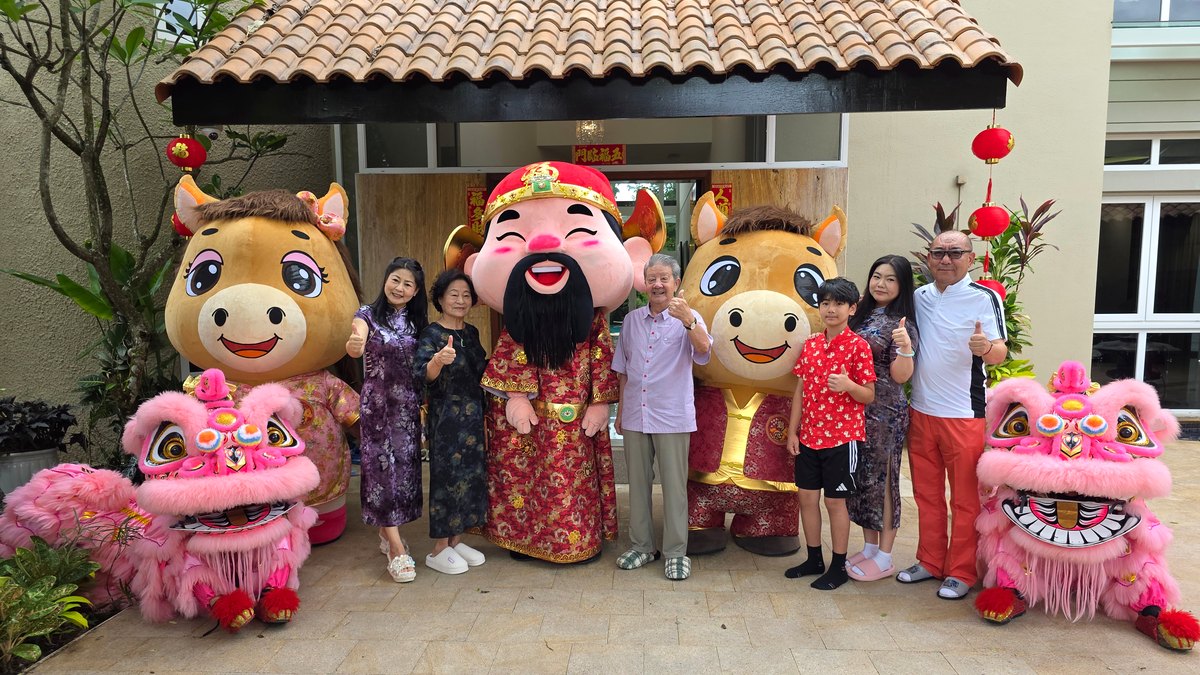
Cartoon mascots and a traditional God of Fortune at the same Chinese New Year event.
| Cartoon God of Fortune mascot | Traditional God of Fortune | |
|---|---|---|
| Look | Full costume with an oversized cartoon head | Performer's own face in theatrical make-up, robe, hat and long beard |
| Speaks to guests | Mostly gestures, waves and poses | Can greet guests face to face |
| Works best for | Malls, family days, children, crowd-gathering | Office greetings, banquets, management photos |
| Typical role | Playful interaction and leading guests to the lion dance | Formal New Year greetings and handing out red packets |
| Also available as | Zodiac mascots, for the animal of the year | Group appearances, such as performers dressed as the Five Gods of Wealth |
A useful rule: if most of your guests are children or shoppers, the mascot wins. If the moment that matters is the chairman receiving a New Year blessing in front of staff, the traditional God of Fortune carries more weight.
Pairing the God of Fortune with a lion dance
The God of Fortune is often booked alongside a lion dance, since both carry the same wish for luck in the new year. The National Heritage Board's lion dance entry on Roots.gov.sg describes lion dances as a common sight in Singapore during Chinese New Year, believed to be bearers of good luck, and explains the cai qing routine in which the lion "plucks the green" to symbolise good fortune.
A running order that works for most offices and shops:
God of Fortune arrives first and greets guests at the entrance or reception.
He leads guests to the performance area while the drums start.
The lions perform, including cai qing if it has been arranged.
The God of Fortune returns for red packets and photos with management and guests.
Starting with the God of Fortune gives late arrivals a few minutes to gather, and finishing with him means the photos happen while everyone is still in a good mood and the lions are packing up. If you are also planning a dragon dance, war drums or a high-pole lion display, SG Hexin lists these on its services page; tell the troupe early, as these need more space and more performers.
Etiquette for staff and guests when he hands out red packets
Nobody expects your staff to know temple protocol, but a few habits make the moment smoother and look better in the photos. These are common courtesies rather than rules:
Receive the red packet with both hands, or at least with the right hand, and say "Gong xi fa cai" or simply "thank you".
Do not open it in front of the God of Fortune. Put it away and look later.
Let senior management and older guests receive theirs first if the organiser has asked for that order.
Keep the queue for photos short. One photo per group, then move along.
On what is inside: SG Hexin's services page says its God of Fortune red packets contain lucky coins or symbolic blessings. If your company wants staff to receive cash, prepare and fund those red packets yourself and agree with the troupe beforehand that the God of Fortune will hand them out. Count them and hand them over before the visit starts, with a note of who receives which.
Booking a God of Fortune for your CNY event
Chinese New Year 2027 begins on 6 February, and the festive weeks are when most companies, shops and malls want a God of Fortune or a lion dance, so book as soon as your date is fixed. To get a clear reply, send the troupe:
the date and time, and if you want the first working day, the fifth day or a lunch or dinner;
the venue and the route you want him to take (reception, floors, tables);
which version you prefer, cartoon mascot or traditional, or both;
if you also want a lion dance with cai qing at the same visit;
who prepares the red packets, and roughly how many guests there will be.
You can see past God of Fortune and lion dance appearances in SG Hexin's photo gallery and performance videos. When your plan is ready, send the details through the contact page or read more about the troupe and its approach first.
Frequently asked questions
What is Cai Shen Ye?
Cai Shen Ye is the Chinese God of Wealth, with "Ye" added as a term of respect. He is honoured at Chinese New Year for prosperity in the coming year. In Singapore he often appears at company and mall events as a costumed God of Fortune who greets guests and hands out red packets.
How do you pronounce Cai Shen Ye?
In Mandarin it is cái shén yé, which sounds roughly like "tsai shun yeh". The "c" is pronounced like the "ts" in "cats". All three syllables rise in tone.
Who is the Chinese god of money?
Cai Shen, the God of Wealth, is the figure most people mean. Different traditions identify him with different legendary figures, including Zhao Gongming and Bi Gan. At Chinese New Year he is greeted with the wish "Gong xi fa cai", meaning "may you prosper".
What day do you welcome the God of Wealth?
Traditionally on the fifth day of the first lunar month. Chinese New Year 2027 begins on Saturday 6 February, so the fifth day is Wednesday 10 February 2027. Many Singapore companies hold their God of Fortune visit on the first working day back or at a company lunch instead.
Does the God of Fortune give out real money in the red packets?
SG Hexin's services page says its God of Fortune hands out red packets containing lucky coins or symbolic blessings. If you want staff to receive cash, prepare those red packets yourself and arrange for the God of Fortune to present them.


Comments